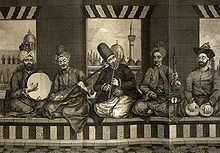
Arabic music or Arab music (Arabic: الموسيقى العربية, romanized: al-mūsīqā al-ʿArabīyah ) is the music of the Arab earth with all its diverse music styles and genres. Arabic countries accept many rich and varied styles of music and also many linguistic dialects, with each country and region having their ain traditional music.
Standard arabic music has a long history of interaction with many other regional musical styles and genres. It represents the music of all the peoples that brand up the Arab world today, all the 22 states.
History [edit]
Pre-Islamic catamenia (Arabian Peninsula) [edit]
Pre-Islamic Arabia was the cradle of many intellectual achievements, including music, musical theory and the development of musical instruments.[one] In Yemen, the main center of pre-Islamic Arab sciences, literature and arts, musicians benefited from the patronage of the Kings of Sabaʾ who encouraged the development of music.[two] [3] For many centuries, the Arabs of Hejaz recognized that the all-time real Arabian music came from Yemen, and Hadhrami minstrels were considered to be superior.[3] Pre-Islamic Arabian Peninsula music was similar to that of Ancient Middle Eastern music. Most historians concord that there existed distinct forms of music in the Arabian peninsula in the pre-Islamic menstruum between the 5th and 7th century Advertizement. Arab poets of that time—called shu`ara' al-Jahiliyah (Standard arabic: شعراء الجاهلية) or "Jahili poets", meaning "the poets of the menses of ignorance"—used to recite poems with a high notes.[2]
It was believed that Jinns revealed poems to poets and music to musicians.[2] The choir at the time served as a pedagogic facility where the educated poets would recite their poems. Singing was not thought to be the work of these intellectuals and was instead entrusted to women with beautiful voices who would acquire how to play some instruments used at that time such equally the drum, the lute or the rebab, and perform the songs while respecting the poetic metre.[two] The compositions were unproblematic and every singer would sing in a single maqam. Amidst the notable songs of the period were the huda (from which the ghina derived), the nasb, sanad, and rukbani.
Early Islamic flow [edit]

Both compositions and improvisations in traditional Arabic music are based on the maqam system. Maqams can be realized with either song or instrumental music, and do not include a rhythmic component.
Al-Kindi (801–873 AD) was a notable early theorist of Arabic music. He joined several others like al-Farabi in proposing the addition of a makeshift 5th string to the oud. He published several tracts on musical theory, including the cosmological connotations of music.[four] He identified twelve tones on the Arabic musical calibration, based on the location of fingers on and the strings of the oud.[five]
Abulfaraj (897–967) wrote the Kitab al-Aghani, an encyclopedic collection of poems and songs that runs to over xx volumes in mod editions.
Al-Farabi (872–950) wrote a notable book on Islamic music titled Kitab al-Musiqa al-Kabir (The Great Book of Music). His pure Arabian tone system is withal used in Arabic music.[six]
Al-Ghazali (1059–1111) wrote a treatise on music in Persia which alleged, "Ecstasy ways the state that comes from listening to music".
In 1252, Safi al-Din developed a unique class of musical notation, where rhythms were represented by geometric representation. A similar geometric representation would not appear in the Western world until 1987, when Kjell Gustafson published a method to represent a rhythm as a ii-dimensional graph.[seven]
Al-Andalus [edit]
By the 11th century, Islamic Iberia had become a centre for the manufacture of instruments. These goods spread gradually throughout France, influencing French troubadours, and somewhen reaching the rest of Europe. The English words lute, rebec, and naker are derived from Arabic oud, rabab, and naqareh.[8] [ix] [ vague ]
16th to 19th century [edit]
Bartol Gyurgieuvits (1506–1566) spent 13 years as a slave in the Ottoman empire. After escaping, he published De Turvarum ritu et caermoniis in Amsterdam in 1544. Information technology is one of the starting time European books to describe music in Islamic society.[ten]
20th century–nowadays [edit]
Egypt and the Levant [edit]
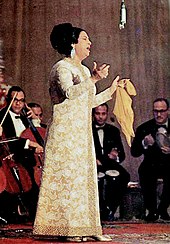
In the early 20th century, Arab republic of egypt was the first in a series of Arab countries to feel a sudden emergence of nationalism, as information technology became independent after 2000 years of strange dominion. Any English, French or European songs got replaced by national Egyptian music. Cairo became a center for musical innovation.

Female singers were some of the first to take a secular approach. Egyptian performer Umm Kulthum and Lebanese vocalizer Fairuz were notable examples of this. Both have been popular through the decades that followed and both are considered legends of Arabic music. Across the Mediterranean, Moroccan singer Zohra Al Fassiya was the first female performer to reach wide popularity in the Maghreb region, performing traditional Arab Andalusian folk songs and later recording numerous albums of her own.
During the 1940s and 1960s, Standard arabic music began to take on a more than Western tone – Egyptian artists Umm Kulthum and Abdel Halim Hafez along with composers Mohammed Abdel Wahab and Baligh Hamdi pioneered the use of western instruments in Egyptian music. Past the 1970s several other singers had followed adjust and a strand of Arabic pop was built-in. Arabic pop usually consists of Western styled songs with Arabic instruments and lyrics. Melodies are often a mix betwixt Eastern and Western. Beginning in the mid-1980s, Lydia Canaan, musical pioneer widely regarded as the first rock star of the Middle East[11] [12] [13] [14] [15] fused English lyrics and Western audio with Middle-Eastern quarter tones and microtones and became the showtime internationally successful Lebanese recording creative person.[16] [17] [eighteen]
Western pop music was besides existence influenced by Arabic music in the early 1960s, leading to the development of surf music, a rock music genre that subsequently gave rise to garage rock and punk stone.[nineteen] Surf stone pioneer Dick Dale, a Lebanese American guitarist, was greatly influenced past the Arabic music he learnt from his uncle, peculiarly the oud and derbakki (doumbek) drum, skills which he subsequently applied to his electric guitar playing when recording surf rock in the early 1960s.[xix]
In the 1990s, several Arab artists accept taken upwards such a fashion including Amr Diab, Najwa Karam, Elissa, Nawal Al Zoghbi, Nancy Ajram, Haifa Wehbe, Angham, Fadl Shaker, Majida Al Roumi, Wael Kfoury, Asalah Nasri, Myriam Fares, Carole Samaha, Yara, Samira Said, Hisham Abbas, Kadhem Al Saher, Mostafa Amar, Ehab Tawfik, Mohamed Fouad, Diana Haddad, Mohamed Mounir, Latifa, Cheb Khaled, George Wassouf, Hakim, Fares Karam, Julia Boutros, and Amal Hijazi.
Republic of iraq [edit]

Kadim Al Sahir known as "The Caesar" of Standard arabic songs. Considered every bit i of the most successful singers in the history of the Arab World.
Due to Iraq's diversity and the long history, the land encompasses the music of a number of ethnic groups and musical genres. In 1936, Republic of iraq Radio was established by two of Iraq's most prominent performers and composers, the Iraqi Jewish musicians, Saleh and Daoud al-Kuwaity with an ensemble, with the exception of the percussion role player. The brothers had a pioneering role in the mod music of Iraq. Saleh was considered the begetter of Iraqi maqam as he was the pioneer of its get-go song.[twenty] He too equanimous for the most famous singers of that era in Iraq and in the Arab world, such as Salima Murad, Afifa Iskandar, Nazem al-Ghazali, Umm Kulthum, Mohammed Abdel Wahab.[21] [22]
One of the main reasons for the predominance of Jewish instrumentalists in early 20th century Iraqi music was a prominent schoolhouse for bullheaded Jewish children in Baghdad, which was founded in the late 1920s by the slap-up qanunji ("qanun player") Joseph Hawthorne (Yusef Za'arur) (Hebrew: דנדהי ללוואלד-יוסף זערור).
Salima Pasha was i of the most famous singers of the 1930s–1940s. The respect and adoration for Pasha were unusual at the time, since public performance by women was considered shameful by some countries in the region, and most female singers were recruited from brothels.[23] [24]
The music in Iraq began to take a more Western tone during the 1960s and 1970s, notably by Ilham Madfai, with his Western guitar stylings with traditional Iraqi music which made him a pop performer in his native country and throughout the Middle East.[25] [26]
Influence of Arabic music [edit]

12th century Arabic painting of musicians in Palermo, Sicily.
The majority of musical instruments used in European medieval and classical music have roots in Arabic musical instruments that were adopted from the medieval Arab world.[27] [28] They include the lute, which shares an antecedent with the oud; rebec (an antecedent of the violin) from rebab, guitar from qitara, naker from naqareh, adufe from al-duff, alboka from al-buq, anafil from al-nafir, exabeba (a type of flute) from al-shabbaba, atabal (a blazon of bass drum) from al-tabl, atambal from al-tinbal,[28] the balaban, castanet from kasatan, and sonajas de azófar from sunuj al-sufr.[29]
The Arabic rabāb, too known as the spiked dabble, is the earliest known bowed cord musical instrument and the ancestor of all European bowed instruments, including the rebec, the Byzantine lyra, and the violin.[thirty] [31] The Arabic oud in Arab music shares an ancestor with the European lute.[32] [ failed verification ] The oud is too cited as a forerunner to the modern guitar. The guitar has roots in the 4-cord oud, brought to Iberia by the Moors in the eighth century.[33] A direct ancestor of the modern guitar is the guitarra morisca (Moorish guitar), which was in employ in Spain by the 12th century. By the 14th century, it was simply referred to as a guitar.[34]
A number of medieval conical bore instruments were likely introduced or popularized past Arab musicians,[35] including the xelami (from zulami).[36]
Some scholars believe that the troubadors may have had Arabian origins, with Magda Bogin stating that the Arab poetic and musical tradition was one of several influences on European "ladylike dearest poetry".[37] Évariste Lévi-Provençal and other scholars stated that three lines of a verse form by William IX of Aquitaine were in some form of Standard arabic, indicating a potential Andalusian origin for his works. The scholars attempted to translate the lines in question and produced various different translations. The medievalist Istvan Frank contended that the lines were not Standard arabic at all, merely instead the result of the rewriting of the original by a later scribe.[38]
The theory that the troubadour tradition was created past William after his feel of Moorish arts while fighting with the Reconquista in Spain has been championed by Ramón Menéndez Pidal and Idries Shah. George T. Beech states that there is only one documented boxing that William fought in Spain, and information technology occurred towards the cease of his life. Beech adds that William and his begetter did have Spanish individuals within their extended family unit, and that while there is no evidence he himself knew Arabic, he may take been friendly with some Europeans who could speak the language.[38] Others state that the notion that William created the concept of troubadours is itself incorrect, and that his "songs stand for not the beginnings of a tradition but summits of achievement in that tradition."[39]
Almost scholars believe that Guido of Arezzo'southward Solfège musical notation system had its origins in a Latin hymn,[xl] but others suggest that it may have had Standard arabic origins instead. It has been argued that the Solfège syllables (do, re, mi, fa, sol, la, ti) may have been derived from the syllables of an Arabic solmization system Durr-i-Mufassal ("Separated Pearls") (dal, ra, mim, fa, sad, lam). This was first proposed by Meninski in his Thesaurus Linguarum Orientalum (1680). However, there is no documentary bear witness for this theory, and no Arabic musical manuscripts using sequences from the Arabic alphabet are known to exist.[41] Henry George Farmer believes that there is no firm evidence on the origins of the notation, and therefore the Arabian origin theory and the hymnal origin theories are every bit apparent.[42]
Improvisational Music in the Arabic Mediterranean region. [edit]
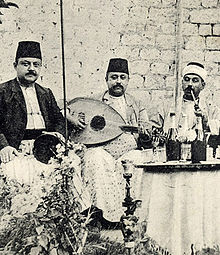
Ethnomusicologist Ali Jihad Racy talks nigh the improvisation way of music that is present in much of the Mediterranean globe.[43] Racy discusses the regional attitudes towards improvisation music in the Centre East describing that improvisation tin can propose casual or untrained or even non-professional person music-making.[44] This is held only by sure communities within the Arabic world and can differ from each region or community.[45] [46] Some regions look at improvisation music as the intuitive artistic ability that momentarily expresses the feeling of the player.[47] [48] Other groups tend to view improvisation every bit though it is the fulfillment of music transcending the classical maqam style or other styles of music playing.[49] [50] Other schools of thought on improvisation music, in the Arab world, believe that improvisation music shows a lack of understanding in musical training.[51] Racy does non specify which groups have what views. Rather, the word is more than focused on the idea that the Arabic music world is not monolithic in its view on improvisation in music. Other groups view improvisation as just learned through trial and error taking many years to perfect thus being a mode played professionals.[52]
Taqasim [edit]
A respectable tradition in improvisation music is known equally Taqasim.[53] Taqasim music uses a maqam and improvises the grade or structure of the song, which creates a cathartic feel for the listener.[54] Farther, the improvisation aspects get across the form and are expressed in the quartertones of the song.[55] This tradition historically was performed as a chant. At present it is used past performers on the oud/ud, violin, or nay, a type of flute.[56] This manner of improvisation is known for the effects it can conjure from a listener.[57] Listeners have been known to laugh, weep, and shout, all from dissimilar parts of the same performance due to the improvisation music aligning exactly to depict extreme emotion from someone.[58]
Improvisation in Chant [edit]
- A certain type of Arabic dirge is in the melismatic style and is both long and highly ornamented.[59] It has specific elements of free rhythm and improvisation equally office of its structure. Syllabic dirge is isochronic and is accompanied by an al-durbkkeh (a percussion instrument. drum.) while being relatively fast in its nature.[60] There is usually participation from the listeners who contribute through the clapping of easily to the rhythm.[61]
- Ethnomusicologist Jargy tells of some other type of improvisation music in which he uses the name Median [62] . This music is a combination of the syllabic chant and the melismatic style. Median improvisation music uses more extreme improvisation methods and expands the boundaries of improvisation and is unremarkably faster than syllabic dirge.[63]
- The concluding improvisation way discussed by Jargy is the recitative way that is sung predominantly by women and is congenital on audible tradition.[64]
Genres [edit]
Franco-Arabic [edit]
Franco-Arabic music is a popular form of W-meets-Eastward style of music, similar in many respects to modern Arabic Pop. This blend of western and eastern music was popularized by artists such as Dalida (Arab republic of egypt), Sammy Clark (Lebanon), and Aldo from Australia. Although Franco-Arabic music includes many forms of cross-cultural blending between the Westward and the Heart East, musically the genre crosses over many lines every bit is seen in songs that incorporate Arabic and Italian, Arabic and French and, of course, Arabic and English styles or lyrics.[65]
Arabic R&B, reggae, and hip hop [edit]
There has also been a rising of R&B, reggae and hip hop influenced Arab music in the past couple of years. These songs ordinarily feature a rapper in a traditional Arab pop song (such as Ishtar's vocal 'Habibi Sawah'). The Moroccan singer Elam Jay adult a contemporary version of the Gnawa genre that is fused with R&B which he named Gnawitone Styla. Another variation of gimmicky Gnawa played in Morocco is introduced by Darga. Based in Casablanca, the group fuses Gnawa with Reggae.[ commendation needed ] Political Reggae artists such as TootArd from the occupied Syrian Golan Heights and from Haifa (Originally from Iqrith) started gaining popularity in Palestine in 2011 after the YouTube premiere of a song about the Arab Spring (mainly the Tunisian revolution), called "The Green Revolution", sung by them and an ensemble of Palestinian artists, nigh notable amid them being Mahmoud Jrere of DAM.[ citation needed ] Notable is Shadia Mansour, a Palestinian British rapper known every bit "The Start Lady of Arab Hip Hop."[ citation needed ] Much of her music focuses on the Palestinian cause.
Also there is the Moroccan pop introduced by the Moroccan vocalist Oussama Belhcen who'south mixing between the American and the Moroccan music in his songs.[66]
Notwithstanding sure artists accept taken to using full R&B and reggae beats and styling such as Darine. This has been met with mixed critical and commercial reaction.[ citation needed ] Equally of now it is not a widespread genre.
Arabic electronica [edit]
Electronic trip the light fantastic toe music is another genre to come out into popularity. Frequently, songs in this genre would combine electronic musical instruments with traditional Middle Eastern instruments. Artists like Richii popularized this manner with songs similar "Ana Lubnaneyoun".
Arabic jazz [edit]
Another popular class of Westward meets Due east, Arabic jazz is likewise pop, with many songs using jazz instruments. Early jazz influences began with the use of the saxophone past musicians similar Samir Suroor, in the "oriental" style. The use of the saxophone in that manner tin be found in Abdel Halim Hafez'southward songs, equally well as Kadim Al Sahir and Rida Al Abdallah today. The first mainstream jazz elements were incorporated into Arabic music by the Rahbani brothers. Fairuz's subsequently work was nigh exclusively fabricated upwards of jazz songs, composed by her son Ziad Rahbani. Ziad Rahbani also pioneered today'south oriental jazz movement, to which singers including Rima Khcheich, Salma El Mosfi, and (on occasion) Latifa adhere. We can also find a lot of jazz music in Mohamed Mounir's songs starting from his first album Alemony Eneeki in 1977, and he is considered to be the Male monarch of Standard arabic Jazz and Standard arabic Music more often than not.[ citation needed ] Another notable performer of this genre is the Palestinian vocaliser Reem Kelani who blends jazz with Arabic music, both in her ain compositions and in her arrangements of traditional songs.[67] [68]
Arabic Jazz has met many new kinds of composition since the terminate of the 20th century:
- Modal forms with Anouar Brahem and Rabih Abou Khalil
- Mixed electric sound experiences with Dhafer Youssef and Kamal Musallam
- New popular jazz styles with Titi Robin and Toufic Farroukh
- Other acoustic youth experiences with Hamdi Makhlouf, Amine & Hamza M'raihi and Jasser Haj Youssef
Arabic rock [edit]
Rock music is popular all around the world, the Arab globe being no exception. There have been many Arab rock bands along the years that fused stone, metal and culling rock sounds with traditional Arab instruments.[ citation needed ]
Arabic rock has been gaining a lot of attending lately in the Middle East with bands like JadaL, Kayan, Autostrad, El Morabba3 and Akher Zapheer of Jordan, The Wanton Bishops, Mashrou' Leila and Meen of Lebanon, Cairokee, Massar Egbari, Sahara, Wyvern and Drawing Killerz of Egypt, Khalas, and Anarchy of Palestine and Acrassicauda of Iraq. The Tunisian rock band Myrath is gaining popularity worldwide. The band Hoba Hoba Spirit from Morocco is likewise gaining popularity, especially in the Maghrebi region. Rachid Taha, an Algerian musician, played a fusion of rock and raï.
Recently, at that place has been a new wave of bands emerging in the underground scene beyond the Arab globe. These include Shaghaf, Khayal, Sada That, Code Masr and Hawas of Egypt and Ayloul of Lebanon.
Musical regions [edit]
The world of modern Standard arabic music has long been dominated by musical trends that have emerged from Cairo, Egypt. The city is by and large considered one of the important cultural centers in the Arab earth. Innovations in popular music via the influence of other regional styles have also abounded from Morocco to Saudi Arabia. In recent years, Beirut has become an important urban center where singers can fluently sing in diverse Arabic Dialects. Other regional styles that accept enjoyed pop music status throughout the Arab world, including:
North Africa [edit]

A collection of 1980s Raï albums.
- Al Jeel (Egypt)
- Shaabi Music (Arab republic of egypt)
- Mawwal (Egypt)
- Semsemya (Egypt)
- Andalusian classical music (Morocco and Algeria) and Tunisia
- Malouf (Libya)
- Chaabi (Algeria)
- Chaabi (Kingdom of morocco)
- Gnawa (Kingdom of morocco and the southwest of Algeria)
- Haqibah
- Malhun (Morocco)
- Mezwed (Tunisia)
- Raï (Algeria)
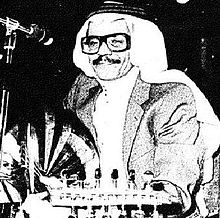
Arabian Peninsula [edit]
- Adani
- Ardah
- Ardham
- Bandari Khaliji
- Dazah
- Fann at-Tanbura
- Fijiri
- Khabayti
- Khaliji
- Khuwizaani
- Liwa
- Mizmar
- 1000'alayah
- Rumba Khaliji
- Samri
- Sawt
- Shaabi Khaliji
- Yanbaawi
- Yowlah
- Zafah Khaliji
Sacred and Art music [edit]
Sacred music [edit]
Arabic religious music includes Jewish (Pizmonim and Baqashot), Christian, and Islamic music. However, Islamic music, including the Tajwid or recitation of Qur'an readings, is structurally equivalent to Arabic secular music, while Christian Arab music has been influenced by Syriac Orthodox, Catholic, Greek Orthodox, Anglican, Coptic, and Maronite church music.[69]
Art music [edit]
Secular fine art musical genres include maqam al-iraqi, andalusi nubah, muwashshah, Fijiri songs, qasidah, layali, mawwal, taqsim, bashraf, sama'i, tahmilah, dulab, sawt, and liwa.[70]
Characteristics of Standard arabic music [edit]

Much of Arabic music is characterized by an accent on melody and rhythm, as opposed to harmony. At that place are some genres of Standard arabic music that are polyphonic, simply typically, Arabic music is homophonic.[71]
Habib Hassan Touma submits that at that place are five components that narrate Arabic music:[72]
- The Arab tone system; that is, a musical tuning system that relies on specific interval structures and was invented past al-Farabi in the tenth century[6]
- Rhythmic-temporal structures that produce a rich diversity of rhythmic patterns, known as awzan or "weight", that are used to accompany metered vocal and instrumental genres, to accent or give them course.
- A number of musical instruments that are found throughout the Arab world that stand for a standardized tone system, are played with more often than not standardized performance techniques, and brandish similar details in construction and design.
- Specific social contexts that produce sub-categories of Arabic music, or musical genres that can exist broadly classified every bit urban (music of the city inhabitants), rural (music of the state inhabitants), or Bedouin (music of the desert inhabitants)..."
- An Arab musical mentality, "responsible for the esthetic homogeneity of the tonal-spatial and rhythmic-temporal structures throughout the Arab earth whether composed or improvised, instrumental or vocal, secular or sacred." Touma describes this musical mentality as being composed of many things.
Maqam system [edit]

A Maqam tone level instance
The basis of Arabic music is the maqam (pl. maqamat), which looks like the mode, but is non quite the same.[ clarification needed ] The tonic note, dominant notation, and ending note (unless modulation occurs) are generally determined by the maqam used. Arabic maqam theory as described in literature over the ages names between 90 and 110 maqams, that are grouped into larger categories known as fasilah. Fasilah are groupings of maqams whose first four primary pitches are shared in common.[73]
Ajnas [edit]
The maqam consists of at to the lowest degree two ajnas, or calibration segments. Ajnas is the plural form of jins, which in Arabic comes from the Latin give-and-take genus, meaning "type". In exercise, a jins is either a trichord (three notes), a tetrachord (4 notes), or a pentachord (five notes). A maqam usually covers only 1 octave (usually two ajnas), but can encompass more. Like the melodic pocket-sized scale, some maqamat utilize unlike ajnas when descending and ascending. Due to continuous innovation and the emergence of new ajnas, and because most music scholars have not reached consensus on the subject, a solid figure for the total number of ajnas in use is uncertain. In practice, however, well-nigh musicians would agree in that location are at least viii major ajnas: rast, bayat, sikah, hijaz, saba, kurd, nahawand, and ajam, and commonly used variants such as nakriz, athar kurd, sikah beladi, saba zamzama. For instance, Mukhalif is a rare jins (in the Sikah) family used about exclusively in Iraq, and it is not used in combination with other ajnas.
Microtones in Arabic music [edit]
Different the tradition of Western music, Arabic music contains microtones, which are notes that lie betwixt notes in the Western chromatic scale. While notes in the chromatic calibration are separated past semitones (or one-half steps), notes in Arabic music tin be separated by quarter tones. In some treatments of theory, the quarter tone scale or all twenty four tones should exist, but according to Yūsuf Shawqī (1969), fewer tones are used in do.[vi]
Additionally, in 1932, at the Cairo Congress of Arab Music held in Cairo, Egypt—and attended by such Western luminaries equally Béla Bartók and Henry George Farmer—experiments were done that adamant conclusively that the notes in bodily use differ substantially from an even-tempered 24-tone scale. Furthermore, the intonation of many of those notes differ slightly from region to region (Egypt, Turkey, Syria, Iraq).
Regional scales [edit]
As a outcome of these findings, the following recommendation was issued: "The tempered calibration and the natural calibration should be rejected. In Arab republic of egypt, the Egyptian scale is to be kept with the values, which were measured with all possible precision. The Turkish, Syrian, and Iraqi scales should remain what they are...."[74] Both in modern practise, and evident in recorded music over the grade of the concluding century, several differently-tuned Es in between the Eastward-flat and E-natural of the Western Chromatic calibration are used, that vary according to the types of maqams and ajnas used, and the region in which they are used.
Applied treatment [edit]
Musicians and teachers refer to these in-between notes equally quarter tones, using "one-half-flat" or "one-half-sharp" equally a designation for the in-between flats and sharps, for ease of nomenclature. Performance and educational activity of the exact values of intonation in each jins or maqam is unremarkably done by ear. It should likewise exist added, in reference to Habib Hassan Touma'southward comment above, that these quarter tones are non used everywhere in the maqamat: in practice, Arabic music does not modulate to 12 unlike tonic areas similar the Well-Tempered Klavier. The almost commonly used quarter tones are on E (between East and Due east ♭ ), A, B, D, F (between F and F ♯ ), and C.
Vocal traditions [edit]
Arab classical music is known for its famed virtuoso singers, who sing long, elaborately ornamented, melismatic tunes, coloraturas unheard in any other musical genres and are known for driving audiences into ecstasy. Its traditions come from pre-Islamic times, when female singing slaves entertained the wealthy, inspired warriors on the battlefield with their rajaz poetry, and performed at weddings. A vast number of female Arab vocalists are mezzo-sopranos who possess darker and richer tones than generic Soprano voices as a consequence of having thicker vocal folds and larger larynx.
Instruments and ensembles [edit]

The prototypical Arabic music ensemble in Egypt and Syrian arab republic is known as the takht, and includes, (or included at different time periods) instruments such as the 'oud, qānūn, rabab, ney, violin (introduced in the 1840s or 50s), riq and dumbek. In Iraq, the traditional ensemble, known as the chalghi, includes only two melodic instruments—the jowza (similar to the rabab but with 4 strings) and santur—accompanied past the riq and dumbek. The Arab world has incorporated instruments from the West, including the electric guitar, cello, double bass and oboe, and incorporated influences from jazz and other foreign musical styles.
The singers have remained the stars, all the same, especially after the development of the recording and motion-picture show industry in the 1920s in Cairo. These singing celebrities are (or were) the biggest stars in Arabic archetype music, they include Farid Al Attrache, Asmahan, Abdel Halim Hafez, Sayed Darwish, Mohamed Abdel Wahab, Warda Al-Jazairia, Wadih El Safi, Fairuz, Sabah, and Umm Kulthum.
Inquiry and documentation of Arabic music [edit]
Fifty-fifty though musical traditions in the Arab world have been handed downwards orally, Arab scholar Al-Kindi,and Persian scholars Abulfaraj or Al-Farabi and afterward Safi al-Din published treatises in Arabic on Persian music since at to the lowest degree the 9th century AD. In 1932, the first Congress of Arab Music was held in Cairo, where scholarship most the past, nowadays and future of Arabic music was presented both from Western equally well every bit Arab experts. The results were afterwards documented, both in writing as well equally in the course of sound recordings.[75]
Research on Arabic music is a focus of departments of ethnomusicology at universities worldwide, and the global interest in Globe music has led to a growing number of studies and re-problems of historic recordings by contained researchers or private companies.[76]
Making utilise of digital archives for texts, pictures and sounds, detailed information on the history of Arabic music is also fabricated attainable over the Internet. The Lebanese foundation AMMAR, for example, is committed to the preservation and broadcasting of traditional Arab music and has published a host of historical documents.[77]
See too [edit]
- Arabic poetry
- Byzantine music
- Durood
- Hamd
- Islamic music
- Islamic verse
- Mawlid
- Mehfil
- Middle Eastern music
- Music of Africa
- Music of Asia
- Music of Southeastern Europe
- Na'at
- Nasheed
- Pizmonim
- Sufi music
- Sufi poetry
- Sufism
- History of Sufism
- Arabic Oud Firm
- Arabic popular music
References [edit]
- ^ Amnon Shiloah, Music in the Earth of Islam: A Socio-cultural Study, Wayne State University Press, 2000
- ^ a b c d Singing in the Jahili period – khaledtrm.net (in Arabic)
- ^ a b "Sharron Gu, A Cultural History of the Standard arabic Language"
- ^ Farmer, Henry George (1988), Historical facts for the Arabian Musical Influence, Ayer Publishing, ISBN0-405-08496-X, OCLC 220811631 . Pages 241 and 257.
- ^ al-Kindi, Abu Yusuf (2011). Risālāh fi khũbr ta"alif al-alḥān. Translated by SDS Abdoun. pp. 100–115.
- ^ a b c Habib Hassan Touma (1996), The Music of the Arabs, p. 170, trans. Laurie Schwartz, Portland, Oregon: Amadeus Printing, ISBN 0-931340-88-8
- ^ Toussaint, Godfried (Baronial 2004), A Comparison of Rhythmic Similarity Measures (PDF), fifth International Conference on Music Information, archived from the original (PDF) on 7 July 2012, retrieved vi July 2009
- ^ Smith, Douglas Alton (2002). A History of the Lute from Antiquity to the Renaissance. ISBN0-9714071-0-Ten.
- ^ "Asian Music 32, no. 1: Tribal Music of India". Archived from the original on 20 Dec 2008.
- ^ Bohlman, Philip Five. (1987), "The European Discovery of Music in the Islamic World and the "Not-Western" in 19th-Century Music History", The Journal of Musicology, 5 (2): 147–163, doi:x.2307/763849, JSTOR 763849
- ^ O'Connor, Tom. "Lydia Canaan One Step Closer to Rock n' Coil Hall of Fame", The Daily Star, Beirut, 27 April 2016.
- ^ Justin Salhani, The Daily Star, November 17, 2014
- ^ David Livingstone, Campus, No. 8, p. 2, February 1997
- ^ Wafik Ajouz, Cedar Wings, No. 28, p. 2, July–August 1995
- ^ Youmna Aschkar, Eco News, No. 77, p. two, Jan twenty, 1997
- ^ George Hayek, Al-Hayat, No. 12,513, 3 June 1997
- ^ Mireille Khalife, Al-Hayat, Issue No. 13,732, xvi October 2000
- ^ Lydia Canaan Receiving Lebanese International Success Honor
- ^ a b Holgate, Steve (fourteen September 2006). "Guitarist Dick Dale Brought Arabic Folk Song to Surf Music". The Washington File. Agency of International Information Programs, U.South. Section of Land. Archived from the original on twenty October 2011. Retrieved 29 August 2010.
- ^ "Jewish Role in Iraqi Music". www.dangoor.com . Retrieved twenty December 2021.
- ^ "Jewish Role in Iraqi Music". www.dangoor.com . Retrieved twenty December 2021.
- ^ azz (22 March 2015). "ألحان خالدة للأخوين الكويتي تذهل العرب - فنون – رياض المحمداوي". Azzaman (in Arabic). Retrieved 20 December 2021.
- ^ "Baghdad Lives On In Tel Aviv". رصيف 22. 11 July 2017. Retrieved twenty December 2021.
- ^ "Jewish Role in Iraqi Music". world wide web.dangoor.com . Retrieved xx Dec 2021.
- ^ "Ilham al-Madfai: Triumph of the Baghdad Beatle". The Independent. 15 July 2003. Retrieved xx December 2021.
- ^ "Direct outta Baghdad".
{{cite web}}: CS1 maint: url-status (link) - ^ Sachs, Short (1940), The History of Musical Instruments, Dover Publications, p. 260, ISBN978-0-486-45265-4
- ^ a b Farmer 1988, pp. 136–137
- ^ Farmer 1988, p. 137
- ^ "rabab (instrument) – Encyclopædia Britannica". Britannica.com. Retrieved 17 August 2013.
- ^ Encyclopædia Britannica (2009), lira, Encyclopædia Britannica Online, retrieved 20 February 2009
- ^ "ʿūd | musical instrument". Encyclopedia Britannica . Retrieved 6 April 2019.
- ^ Summerfield, Maurice J. (2003). The Classical Guitar: Its Evolution, Players and Personalities Since 1800 (5th ed.). Blaydon on Tyne: Ashley Marker. ISBN1872639461.
- ^ Tom and Mary Anne Evans. Guitars: From the Renaissance to Rock. Paddington Press Ltd 1977 p.16
- ^ Farmer 1988, p. 140
- ^ Farmer 1988, pp. 140–41
- ^ Bogin, Magda; Bogin, Meg (1995). The Women Troubadours. WW Norton. ISBN978-0393009651.
- ^ a b Beech, George T. (1992). "Troubadour Contacts with Muslim Spain and Knowledge of Arabic : New Evidence Concerning William Ix of Aquitaine". Romania. 113 (449): 14–26. doi:10.3406/roma.1992.2180.
- ^ Peter Dronke, The Medieval Lyric, Perennial Library, 1968. p. 111.
- ^ McNaught, West. G. (1893). "The History and Uses of the Sol-fa Syllables". Proceedings of the Musical Association. Novello, Ewer and Co. xix: 35–51. doi:10.1093/jrma/19.1.35. ISSN 0958-8442.
- ^ Miller, Samuel D. (Autumn 1973), "Guido d'Arezzo: Medieval Musician and Educator", Journal of Research in Music Education, 21 (3): 239–45, doi:10.2307/3345093, JSTOR 3345093, S2CID 143833782
- ^ Farmer 1988, pp. 81–82
- ^ Racy, Ali Jihad (2000). "The Many Faces of Improvisation: The Arab Taqāsīm every bit a Musical Symbol". Ethnomusicology. 44 (2): 302–320. doi:10.2307/852534. ISSN 0014-1836. JSTOR 852534.
- ^ Racy, Ali Jihad (2000). "The Many Faces of Improvisation: The Arab Taqāsīm equally a Musical Symbol". Ethnomusicology. 44 (two): 302–320. doi:x.2307/852534. ISSN 0014-1836. JSTOR 852534.
- ^ Racy, Ali Jihad (2000). "The Many Faces of Improvisation: The Arab Taqāsīm every bit a Musical Symbol". Ethnomusicology. 44 (2): 302–320. doi:10.2307/852534. ISSN 0014-1836. JSTOR 852534.
- ^ Nettl, Bruno; Turino, Thomas; Wong, Isabel; Capwell, Charles; Bolman, Philip; Dueck, Byron; Rommen, Timmothy (25 September 2015). Excursions in Earth Music, Sixth Edition. Routledge. ISBN978-1-317-35029-3.
- ^ Racy, Ali Jihad (2000). "The Many Faces of Improvisation: The Arab Taqāsīm as a Musical Symbol". Ethnomusicology. 44 (two): 302–320. doi:x.2307/852534. ISSN 0014-1836. JSTOR 852534.
- ^ Nettl, Bruno; Turino, Thomas; Wong, Isabel; Capwell, Charles; Bolman, Philip; Dueck, Byron; Rommen, Timmothy (25 September 2015). Excursions in Globe Music, 6th Edition. Routledge. ISBN978-ane-317-35029-iii.
- ^ Racy, Ali Jihad (2000). "The Many Faces of Improvisation: The Arab Taqāsīm as a Musical Symbol". Ethnomusicology. 44 (ii): 302–320. doi:x.2307/852534. ISSN 0014-1836. JSTOR 852534.
- ^ Nettl, Bruno; Turino, Thomas; Wong, Isabel; Capwell, Charles; Bolman, Philip; Dueck, Byron; Rommen, Timmothy (25 September 2015). Excursions in World Music, Sixth Edition. Routledge. ISBN978-one-317-35029-3.
- ^ Racy, Ali Jihad (2000). "The Many Faces of Improvisation: The Arab Taqāsīm as a Musical Symbol". Ethnomusicology. 44 (two): 302–320. doi:10.2307/852534. ISSN 0014-1836. JSTOR 852534.
- ^ Racy, Ali Jihad (2000). "The Many Faces of Improvisation: The Arab Taqāsīm as a Musical Symbol". Ethnomusicology. 44 (ii): 302–320. doi:10.2307/852534. ISSN 0014-1836. JSTOR 852534.
- ^ Racy, Ali Jihad (2000). "The Many Faces of Improvisation: The Arab Taqāsīm as a Musical Symbol". Ethnomusicology. 44 (2): 302–320. doi:10.2307/852534. ISSN 0014-1836. JSTOR 852534.
- ^ Racy, Ali Jihad (2000). "The Many Faces of Improvisation: The Arab Taqāsīm as a Musical Symbol". Ethnomusicology. 44 (ii): 302–320. doi:10.2307/852534. ISSN 0014-1836. JSTOR 852534.
- ^ Racy, Ali Jihad (2000). "The Many Faces of Improvisation: The Arab Taqāsīm as a Musical Symbol". Ethnomusicology. 44 (2): 302–320. doi:10.2307/852534. ISSN 0014-1836. JSTOR 852534.
- ^ Racy, Ali Jihad (2000). "The Many Faces of Improvisation: The Arab Taqāsīm as a Musical Symbol". Ethnomusicology. 44 (2): 302–320. doi:10.2307/852534. ISSN 0014-1836. JSTOR 852534.
- ^ Racy, Ali Jihad (2000). "The Many Faces of Improvisation: The Arab Taqāsīm as a Musical Symbol". Ethnomusicology. 44 (ii): 302–320. doi:10.2307/852534. ISSN 0014-1836. JSTOR 852534.
- ^ Racy, Ali Jihad (2000). "The Many Faces of Improvisation: The Arab Taqāsīm as a Musical Symbol". Ethnomusicology. 44 (2): 302–320. doi:ten.2307/852534. ISSN 0014-1836. JSTOR 852534.
- ^ Jargy, Simon (1978). "The Folk Music of Syria and Lebanon". The World of Music. 20 (1): 79–93. ISSN 0043-8774. JSTOR 43562542.
- ^ Jargy, Simon (1978). "The Folk Music of Syria and Lebanese republic". The Globe of Music. twenty (1): 79–93. ISSN 0043-8774. JSTOR 43562542.
- ^ Jargy, Simon (1978). "The Folk Music of Syria and Lebanon". The Globe of Music. 20 (i): 79–93. ISSN 0043-8774. JSTOR 43562542.
- ^ Jargy, Simon (1978). "The Folk Music of Syria and Lebanon". The World of Music. 20 (1): 79–93. ISSN 0043-8774. JSTOR 43562542.
- ^ Jargy, Simon (1978). "The Folk Music of Syria and Lebanese republic". The World of Music. 20 (ane): 79–93. ISSN 0043-8774. JSTOR 43562542.
- ^ Jargy, Simon (1978). "The Folk Music of Syrian arab republic and Lebanon". The Globe of Music. 20 (1): 79–93. ISSN 0043-8774. JSTOR 43562542.
- ^ Celli A. "Ya Catarì. La musica leggera franco-araba". In Alle radici dell'Europa. Mori giudei e zingari nei paesi del Mediterraneo occidentale, vol. III, 20-XXI Century, ed. Felice Gambin. Verona: SEID, 2010 (155–174).
- ^ http://www.assabahia.com/%D8%B9%D9%88%D8%AF%D8%A9-%D8%A7%D9%84%D9%81%D9%86%D8%A7%D9%86-%D8%A7%D9%84%D8%B4%D8%A7%D8%A8-%D8%A3%D8%B3%D8%A7%D9%85%D8%A9-%D8%A8%D8%A7%D9%84%D8%Advertising%D8%B3%D9%86-%D8%A5%D9%84%D9%89-%D8%A7%D9%84%D8%B3/ عودة الفنان الشاب أسامة بالحسن إلى الساحة الغنائية
- ^ "World Music: Towards an Arab-American songbook". Financial Times. xvi Jan 2007.
- ^ "Archived re-create". Archived from the original on 17 Feb 2010. Retrieved one April 2014.
{{cite spider web}}: CS1 maint: archived copy every bit championship (link) - ^ Touma 1996, p. 152.
- ^ Touma 1996, pp. 55–108.
- ^ "Arabian music" on the on-line edition of The Columbia Encyclopedia, Sixth Edition, at world wide web.encyclopedia.com
- ^ Touma (1996), p.xix-xx.
- ^ http://www.musiq.com/makam/page0.html Archived 8 November 2006 at the Wayback Machine Musiq.com
- ^ Maalouf, Shireen (2002). History of Arabic Music Theory: Change and Continuity in the Tone Systems, Genres, and Scales, p.220. Kaslik, Lebanon: Université Saint-Camaraderie.
- ^ Come across the discography and literature on Cairo Congress of Arab Music.
- ^ Faber, Tom (7 June 2019). "The not bad collectors contesting to preserve Arab music". world wide web.ft.com . Retrieved 18 April 2020.
- ^ "Nigh « AMAR Foundation for Arab Music Archiving & Inquiry". Retrieved eighteen Apr 2020.
Farther reading [edit]
- Gild, David and Bill Badley. "Partner of Poetry". 2000. In Broughton, Simon and Ellingham, Mark with McConnachie, James and Duane, Orla (Ed.), Earth Music, Vol. 1: Africa, Europe and the Centre East, pp 323–331. Rough Guides Ltd., Penguin Books. ISBN
- Shiloah, Amnon. Music in the World of Islam. A Socio-Cultural Study 2001. ISBN
- Julián Ribera y Tarragó. La música árabe y su influencia en la española (1985). (in Spanish)
- Fernández Manzano, Reynaldo. De las melodías del reino nazarí de Granada a las estructuras musicales cristianas. La transformación de las tradiciones Hispano-árabes en la península Ibérica. 1984. ISBN 8450511895
- Fernández Manzano, Reynaldo y Santiago Simón, Emilio de (Coordinación y supervisión ed.). Música y Poesía del Sur de al-Andalus. 1995. ISBN 8477823359
- Fernández Manzano, Reynaldo.: La música de al-Andalus en la cultura medieval, imágenes en el tiempo, Granada, Universidad e Granada, 2012. ISBN 9788490280935
External links [edit]
- A Brief History of Arab Music – Video
- Information about history of music from Arabic texts
- Arabic 78 RPM Records Collection at Harvard Loeb Music Library
- Maqam Earth
DOWNLOAD HERE
Posted by: umsteadpironerts.blogspot.com


0 Komentar
Post a Comment